
The dumb supper: Halloween’s silent table
Some links on this page are affiliate links. If you choose to buy through them, I earn a small commission at no extra cost to you.
A dumb supper began with a rule: nobody spoke. Young women cooked and served a meal in complete silence, and in some accounts they worked backward, left the doors open, and set places for visitors they hoped to summon. At midnight, if the charm worked, a future husband, or his apparition, would enter and take an empty chair. Sometimes a coffin came in instead.
For me, the dumb supper reads like a Gothic novel compressed into one night: a house, a ritual, a door left open, and a visitor who might be a husband or might be death. Accounts survive in folklore collections, old newspaper columns, and fiction. I’m interested in what those accounts make of the empty chair, especially when the expected guest turns out to be someone else.
What a dumb supper was
A dumb supper was a marriage charm, and “dumb” meant mute. Unmarried young women held it, often at Halloween, though some places preferred New Year’s Eve or May Eve. In her account of the custom for Atlas Obscura, Anne Ewbank reports that folklorist Wayland D. Hand collected 35 accounts from the British Isles and 100 from the United States.
The instructions differed from one account to another. Silence was central; the backward movements and table arrangements varied. Recorded versions included these rules:
- Nobody spoke from the first step to the last. One word broke the spell.
- Preparations ran backward: participants might walk backward, reverse the table settings, turn the chairs around, or serve dessert first.
- Some versions called for open doors or windows; others required darkness.
- Extra places were set for the expected visitors, who were supposed to arrive at midnight.
The visitor was supposed to reveal a participant’s future. A man or apparition taking the place beside her foretold marriage. In darker stories, a coffin arrived instead, understood as a sign of death rather than a wedding.
Not everyone treated the ceremony solemnly. Accounts also describe it as a party game, with boys interrupting the proceedings or appearing as the expected guests. Ewbank’s overview describes the custom as having largely disappeared by the 1950s.
Where it came from
Related marriage charms were recorded in Britain and later in the United States, including the Southern mountains and the Ozarks. The British dumb cake belongs to the same group of silent courtship rituals. Ewbank’s history of the dumb cake identifies an early written reference in George Sinclair’s Satan’s Invisible World Discovered, published in 1685.
Dumb-cake customs also required silence, though the recipes and instructions varied. Different accounts describe marking the cake with initials, moving backward, or placing a piece beneath a pillow in the hope of dreaming about a future husband. These details belong to several versions of the charm rather than to a single fixed recipe or ceremony.
Hand’s comparison, as summarized by Ewbank, found an emphasis on dumb cakes in English and Scottish accounts and on the backward meal and table settings in American ones. The resemblance connects the customs, but it doesn’t establish a single route by which every American version arrived.
The rest of Halloween night
The dumb supper was one of several courtship charms associated with Halloween. Robert Burns’s poem “Halloween” preserves others, along with his notes explaining them. He wrote it in 1785 and published it in the Kilmarnock edition in 1786.
Burns’s young people, blindfolded, pull kail stalks and read a future spouse’s height and temper from the roots. They name pairs of nuts and set them in the fire to see whether the couple burns quietly together or jumps apart. A girl eats an apple in front of a mirror, alone, expecting a face to appear over her shoulder. Others throw a ball of yarn into a kiln and wind it back, waiting for someone in the dark to hold the other end. Burns’s poem and explanatory notes describe these customs in detail.
These charms promised a name or a face before the marriage itself. In the dumb-supper accounts, that glimpse could become a visit. Someone would enter the room and sit beside her.
The coffin at the table
Some dumb-supper stories turn the marriage charm into a warning. The expected husband isn’t the only thing that might come through the door.
Ewbank recounts a Missouri story discussed by folklorist Paul B. Frazier in which a coffin moves into the room beside one participant while a young man carrying a knife appears beside another. Frazier interprets such unhappy endings as warnings against using magic in courtship.
This is what makes it Gothic to me. The participants have prepared a place for a stranger and agreed to remain silent when he arrives. An ordinary domestic act, setting the table, becomes an invitation they may regret. The coffin makes the danger visible before anyone can explain it away.
Books for reading further
These books offer several entry points into the subject: collected beliefs, scholarship on occult practices, older Halloween customs, and fiction that uses the ritual.
Ozark Magic and Folklore by Vance Randolph

Randolph spent decades collecting beliefs and customs in the Missouri and Arkansas hills, and this is the result, first published in 1947 as Ozark Superstitions. Love charms, witch lore, weather signs, and death omens all sit side by side, recorded in the voices of the people who told them. Read it for the wider body of Ozark belief in which courtship charms belonged.
Find a copy: Bookshop.org | Amazon
Lucifer Ascending by Bill Ellis

Ellis discusses the dumb supper within a broader study of occult belief and practice. His subject includes familiar objects and activities, such as good-luck charms, Ouija boards, and spell books. It provides context for rituals through which people try to encounter the supernatural themselves.
Find a copy: Bookshop.org | Amazon
The Book of Hallowe’en by Ruth Edna Kelley

Published in 1919, Kelley’s book collects Halloween customs and accounts of the holiday’s history. Kelley gathers courtship charms from Scotland, Ireland, and England, including several ways of predicting a future spouse. Its historical interpretations should be read alongside later scholarship. It’s in the public domain in the United States and available for free on Project Gutenberg.
Find a copy: Bookshop.org | Amazon
Halloween: From Pagan Ritual to Party Night by Nicholas Rogers

Rogers is a historian, and his book examines Halloween’s history in Britain and North America, including its religious associations and changing forms of celebration. Read it for the wider history surrounding the courtship customs discussed here.
Find a copy: Bookshop.org | Amazon
Poems, Chiefly in the Scottish Dialect by Robert Burns

“Halloween” first appeared in the 1786 Kilmarnock edition. Choose an edition that includes Burns’s explanatory notes, which describe the charms behind the poem’s action. You can also read the poem and notes online.
Find a copy: Bookshop.org | Amazon
Prayers the Devil Answers by Sharyn McCrumb

McCrumb opens her novel with a dumb supper held at night in an abandoned cabin, and one rule gets broken. Published in 2016, the novel follows a widowed sheriff in Depression-era Tennessee who must carry out an execution. The opening ritual introduces a warning that people later use to explain tragedy.
Find a copy: Bookshop.org | Amazon
Who Fears the Devil? by Manly Wade Wellman
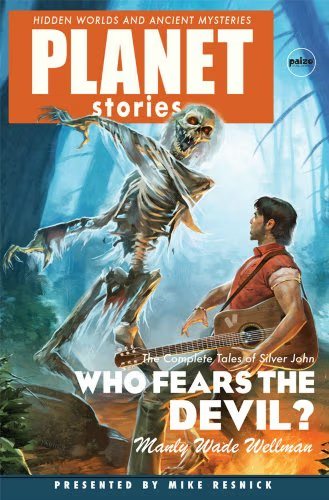
For more mountain folk magic in fiction, there are Wellman’s stories of Silver John, a balladeer who walks the North Carolina mountains carrying a guitar strung with silver. Witches, haints, and folk charms are everyday business in these stories, and Wellman drew on real mountain beliefs. Look for the story “Dumb Supper,” also known as “Call Me from the Valley.”
Find a copy: AbeBooks
Frequently asked questions
A dumb supper is a folk ritual in which unmarried young women prepared a silent meal to discover whom they would marry. Many accounts describe backward preparations and extra places for expected visitors. At midnight, a future husband, or his apparition, was supposed to enter and sit beside a participant.
“Dumb” is the old sense of the word: mute or silent. The whole meal had to happen without a word, and speaking broke the charm.
Accounts associate the custom with Halloween, but the date varied. Hand recorded accounts of the custom being held on New Year’s Eve in California and May Eve in Maryland.
The courtship custom became less common during the twentieth century. Some contemporary Pagan observances use the name “dumb supper” for a silent meal honoring the dead. That purpose differs from the marriage divination described here.
More folk magic and legend
→ Best books on Appalachian folk magic
→ Haints, spirits, and Appalachian ghost belief
→ Folk Gothic: where the land remembers
→ Best books on Italian witchcraft
→ Southern Gothic
→ Folk Magic & Legend hub


