Best Gothic Horror Novels That Still Feel Disturbing
Summary
Gothic horror has never depended on jump scares. It unsettles more quietly — lingering in corridors, pressing against locked doors, whispering through houses that remember too much.
Classic and Modern Gothic Books That Refuse to Stay Buried
Gothic horror has never depended on jump scares.
It unsettles more quietly than that, lingering in corridors long after footsteps fade. Then it presses against locked doors and whispers through houses that remember too much.
Born in the late eighteenth century, Gothic fiction emerged from a fascination with emotion, imagination, and the sublime. It presented us with crumbling castles and isolated estates. Ancestral curses and repressed desires were common themes. It also featured narrators whose grip on reality may not be entirely secure.
But the Gothic is not really about ghosts.
It is about inheritance, silence, and the past bearing down on the present.
The best Gothic horror novels still feel disturbing because they understand that fear is rarely external. It lives inside memory, inside architecture, inside the parts of ourselves we try not to examine too closely.
New to Gothic literature? Start here:
Gothic Literature: A Complete Guide to the Genre
Below are fifteen Gothic novels that continue to unsettle across centuries.
Some links on this page are affiliate links. If you choose to buy, it supports the site at no extra cost to you.
Table of contents
The Haunted House
Some Gothic novels make the building do the work. The house watches, remembers, and presses back. These are novels where architecture is not setting — it is psychology made solid.
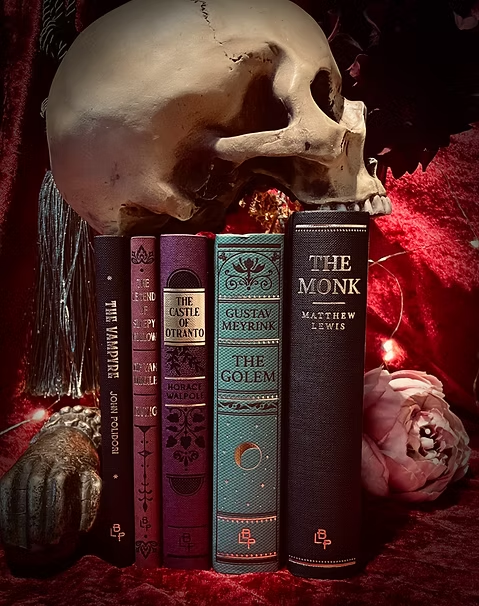
The Castle of Otranto (1764) by Horace Walpole

Often considered the first Gothic novel, Walpole’s story introduced many of the genre’s defining elements. These are ancestral curses, tyrannical fathers, haunted architecture, and supernatural interventions that feel both theatrical and ominous.
What makes it endure is its central anxiety — that the past is not finished with us.
Best for: Readers curious about the origin of Gothic horror.
Find a copy: Bookshop.org | Amazon
Jane Eyre (1847) by Charlotte Brontë

Though often shelved as romance, Jane Eyre is structurally Gothic. It features a brooding estate and a hidden wife. It also includes emotional confinement and uses fire as a revelation.
Its disturbance lies in repression — social, emotional, and architectural. Thornfield becomes a structure built to contain what Victorian society could not comfortably name.
Best for: Readers interested in female Gothic interiority and power.
Find a copy: Bookshop.org | Amazon
Rebecca (1938) by Daphne du Maurier

Manderley feels alive — watching, judging, remembering. The unnamed narrator lives under the shadow of a woman who is no longer alive but remains everywhere.
The horror is subtle and psychological: erasure, comparison, identity dissolving in the presence of someone absent.
Best for: Readers who prefer atmospheric dread to overt terror.
Find a copy: Bookshop.org | Amazon
The Haunting of Hill House (1959) by Shirley Jackson

Hill House may be haunted. Or Eleanor may be unraveling.
The novel’s genius is its ambiguity. The familiar becomes uncanny — a heartbeat, a hand in the dark, a house that seems to echo private thoughts.
It remains one of the most quietly destabilizing Gothic novels ever written.
Best for: Readers who love psychological tension and interpretive space.
Find a copy: Bookshop.org | Amazon
We Have Always Lived in the Castle (1962) by Shirley Jackson

Merricat Blackwood has arranged her world very carefully. The house, the rituals, the sister, the cat. Everything outside the gate is a threat.
Jackson makes the domestic Gothic feel genuinely strange, not haunted-house strange, but something quieter and harder to name. The disturbance is Merricat herself: her logic is perfectly coherent and completely unnerving.
Best for: Readers who found Hill House compelling and want Jackson’s other register — darker, more intimate, almost feral.
Find a copy: Bookshop.org | Amazon
The Woman in Black (1983) by Susan Hill

A remote estate cut off by tides. Fog. Silence. Isolation.
Susan Hill revives the Victorian ghost story with restraint and patience.
The novel disturbs because it never rushes — it allows dread to accumulate slowly.
Best for: Readers who appreciate traditional Gothic atmosphere.
Find a copy: Bookshop.org | Amazon
The Corrupted Self
Not all Gothic horror needs a haunted room. Some of the most disturbing novels in the genre turn inward — obsession, ambition, moral erosion. The monster, when it finally appears, has been there from the beginning.
Frankenstein (1818) by Mary Shelley

Mary Shelley’s novel is more a philosophical meditation than a monster tale. Ambition, abandonment, and moral reckoning shape its icy landscapes and obsessive narration.
The horror here is loneliness. It is the terror of creation without responsibility. It is also the fear of being cast aside by the one who made you.
Best for: Readers drawn to psychological and ethical horror rather than spectacle.
Find a copy: Bookshop.org | Amazon
The Picture of Dorian Gray (1890) by Oscar Wilde

Wilde’s only novel is a Gothic fable wearing evening clothes. Dorian sells his soul for beauty and watches the portrait absorb every cruelty he refuses to feel himself.
The horror is aesthetic — and entirely self-inflicted. Corruption here is not visited upon the protagonist. It is chosen, slowly, with great elegance.
Best for: Readers drawn to Gothic as moral unraveling rather than supernatural menace.
Find a copy: Bookshop.org | Amazon
Dracula (1897) by Bram Stoker

Epistolary and atmospheric, Dracula blends superstition with modern anxieties about science, sexuality, and invasion. Fear moves through letters and journal entries, crossing borders as easily as the Count himself.
Its force endures because it suggests that something ancient survives beneath modern confidence.
Best for: Readers who enjoy layered narratives and cultural tension.
Find a copy: Bookshop.org | Amazon
The Turn of the Screw (1898) by Henry James

The Turn of the Screw is the definitive study in Gothic ambiguity. A governess may be protecting her charges from genuine ghosts. Or she could be projecting her own unraveling onto them.
James refuses to resolve the question. The horror is not knowing.
Best for: Readers who want Gothic fiction that refuses to confirm its own premise.
Find a copy: Bookshop.org | Amazon
Landscape as Dread
These novels replace corridors with open country. The threat is not a locked door but the moor, the rock, the city that has swallowed its own dead. Place here is not a backdrop. It is indifferent, ancient, and completely unmoved by the people standing in it.
Wuthering Heights (1847) by Emily Brontë

The moors are not the backdrop here. They are mood, threat, and mirror. Heathcliff and Catherine’s bond is less romance than obsession — feral, generational, and long after death still unresolved.
What disturbs is the landscape itself. Brontë gives it the same interior life as her characters. The house holds grudges. The weather keeps score.
Best for: Readers who want Gothic that feels elemental rather than architectural.
Find a copy: Bookshop.org | Amazon
Picnic at Hanging Rock (1967) by Joan Lindsay

On a February afternoon in colonial Australia, three schoolgirls and a teacher walk into Hanging Rock and do not come back. Lindsay never explains what happened. The novel doesn’t want to.
The Gothic here is landscape — ancient, indifferent, utterly foreign to the European sensibility, trying to domesticate it. What disturbs is the silence the disappearance leaves behind, and the way the rock continues, unchanged.
Best for: Readers who want Gothic stripped of European conventions — open sky instead of corridors, geological time instead of ancestral curse.
Find a copy: Bookshop.org | Amazon
The Shadow of the Wind (2001) by Carlos Ruiz Zafón

Barcelona, 1945. A boy discovers a novel by an author who seems to have been erased from existence. The search for him leads through a city that is still hiding its own dead.
Zafón builds Gothic out of architecture and secrets — a labyrinthine library, a city under Franco’s shadow, books that carry curses across decades. The dread accumulates the way it does in the best Gothic: slowly, until you realize you’re in deep.
Best for: Readers who want Gothic atmosphere woven through a propulsive story rather than a slow, quiet one.
Find a copy: Bookshop.org | Amazon
Inherited Horror
The past is not finished. It takes up residence, accumulates, and eventually demands to be reckoned with. These novels understand that the most durable Gothic terror is not supernatural but historical.
Beloved (1987) by Toni Morrison

In Beloved, the haunted house becomes a historical reckoning. The past does not rest; it takes shape, voice, and presence.
Morrison transforms Gothic conventions into something political and generational. Memory here is not symbolic. It is embodied.
Its disturbance comes from an inheritance that cannot be escaped.
Best for: Readers who see Gothic horror as a lens for historical trauma.
Find a copy: Bookshop.org | Amazon
Mexican Gothic (2020) by Silvia Moreno-Garcia

A decaying mansion in 1950s Mexico becomes the site of colonial inheritance and bodily horror.
Moreno-Garcia reclaims Gothic tropes and reframes them through the lens of race, empire, and gender. The horror here is systemic — and disturbingly intimate.
Best for: Readers seeking contemporary Gothic with thematic depth.
Find a copy: Bookshop.org | Amazon
These titles are also available at Barnes & Noble.
Gothic Horror for Slow Readers
Gothic horror rewards attention. It asks readers to linger in hallways, in silences, and in subtext.
A few habits that help: pause at chapter breaks rather than pushing through. Notice how setting shifts when a character’s emotional state changes. Reread the opening once you’ve finished. Gothic novels almost always planted something there you missed.
If you are drawn to atmospheric fiction that values ambiguity over shock, check the Reading Lists archive for more. You might also like On Rereading, Marginalia, and a Lifelong Reading Practice.
Why Gothic Horror Endures
Gothic horror lasts because it names what modern life still struggles to say out loud: Fear is rarely about monsters.
It is about what we inherit, what we refuse to confront, and houses built on foundations that were never secure.
That is why these novels still disturb. Not because they frighten, but because they recognize something true.
You can browse all curated reading lists in the Reading Lists archive. If the Gothic and horror titles here appeal to you, the 100 Gothic Horror Books reading guide is a good next stop for you.
Frequently Asked Questions
Gothic horror is a genre defined by atmosphere, isolation, decay, repression, and inheritance. These stories are often set in haunted or oppressive spaces, where fear feels psychological as much as supernatural.
Gothic horror relies on mood, setting, and lingering dread — often tied to the past. Horror more broadly emphasizes shock, gore, monsters, or fast-paced terror.
No. Many Gothic novels keep the supernatural ambiguous, allowing readers to decide whether the threat is a literal haunting or a psychological fracture.
Classic essentials include The Castle of Otranto, Frankenstein, Jane Eyre, Wuthering Heights, Dracula, and The Turn of the Screw. These books shaped Gothic conventions like haunted spaces, secrets, and unreliable narrators.
Modern standouts include Rebecca, The Haunting of Hill House, We Have Always Lived in the Castle, Beloved, The Woman in Black, Mexican Gothic, and The Shadow of the Wind. These novels update Gothic dread through psychological, historical, and cultural lenses.
It depends on what unsettles you. Readers often find The Haunting of Hill House disturbing for its ambiguity. Beloved disturbs for its historical and emotional reckoning. Picnic at Hanging Rock unsettles through what it withholds rather than what it reveals.
Yes. Gothic horror is great for discussion. It invites interpretation: what is real vs imagined, how the past shapes the present, and how setting mirrors psychological confinement.
No. It’s a starting point. Notable works like The Monk, The Strange Case of Dr Jekyll and Mr Hyde, and Wide Sargasso Sea are worth exploring once you’ve moved through these fifteen.