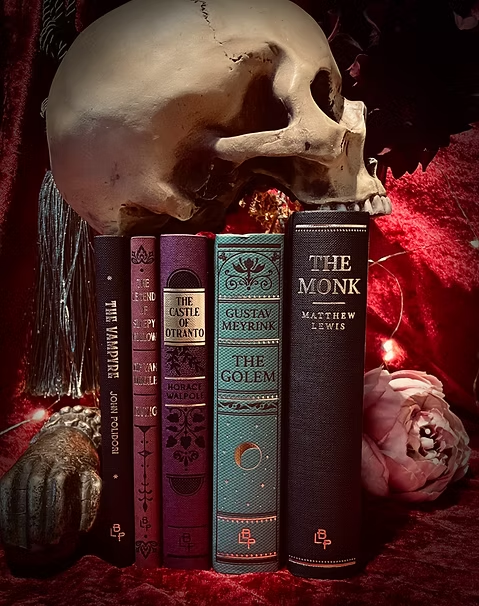
Gothic literature starter pack: 15 books to enter the genre
A reading path through one of fiction’s most enduring obsessions.
New to Gothic literature? Start here:
→ Gothic Literature: A Complete Guide to the Genre
Most people recognize Gothic before they can define it.
It always begins with a feeling you recognize long before you can name it. First, there is a house that seems to remember. Then, there is a character who senses something is wrong yet cannot prove it. And the past keeps returning in ways nobody inside the story fully understands.
If you’re new to the genre, the problem isn’t that you want to read it. It’s knowing where to start. Gothic is wide. It moves from ruined castles to quiet domestic spaces, from ghost stories to psychology, from romance to something considerably darker. It changes form across centuries without losing what makes it Gothic.
This list gives you a way in. You can follow it as a loose reading path, moving roughly in the order the genre developed. Or treat it like a shelf and pull down whatever holds your attention. There’s no correct starting point.
If you’re completely new to the genre, the broader Gothic literature hub provides historical context and reading paths.
Some links on this page are affiliate links. If you choose to buy, it supports the site at no extra cost to you.
The Gothic starter pack
1. The Castle of Otranto (1764) by Horace Walpole

Gothic takes its first shape here, and it’s stranger than you might expect.
Walpole throws everything at the page: ancestral curses, tyrannical fathers, haunted architecture, supernatural intrusions that arrive without warning. It’s dramatic, sometimes almost excessive, but that’s part of what makes it interesting. You’re reading a writer inventing a genre in real time, still working out what it’s allowed to do.
Read it as a beginning. Everything that follows is in conversation with it.
Find a copy → Bookshop.org | Amazon
2. The Mysteries of Udolpho (1794) by Ann Radcliffe

Radcliffe slows everything down.
Where Walpole was abrupt, Radcliffe is patient. The dread builds through landscape, uncertainty, long silences, and the persistent sense that something is being withheld.
Find a copy → Bookshop.org | Amazon
3. Frankenstein (1818) by Mary Shelley

Most people come to this expecting a monster story. What they find is quieter and harder to shake.
Shelley is interested in responsibility. She shows what it means to make something, abandon it, and live with what it becomes. The horror doesn’t announce itself. It accumulates slowly through ice and isolation, and the specific loneliness of being unmade by the person who created you. It shifts Gothic away from spectacle and toward something more internal. Most of what came after it owes it a debt.
If this is the book that pulls you into the genre, continue with Books like Frankenstein.
Find a copy → Bookshop.org | Amazon
4. Dracula (1897) by Bram Stoker

People think they already know this book.
What surprises most first-time readers is the form. Stoker tells it through letters, journal entries, and telegrams. You piece the story together from fragments, which makes it feel immediate even now. The Count isn’t really the horror. The horror is what he represents: something ancient surviving beneath modern confidence, crossing borders, wearing a respectable face. The fragmented structure still feels unexpectedly modern.
Readers who want more epistolary or invasion-based Gothic should continue with Books like Dracula.
Find a copy → Bookshop.org | Amazon
5. Jane Eyre (1847) by Charlotte Brontë

At first glance, this looks like a novel about independence and love. It is. But there’s a house at its center, and that house is hiding something.
The tension comes from what’s never said directly. Thornfield is a structure built to contain what Victorian society couldn’t comfortably name. Gothic doesn’t always arrive as horror. Sometimes it lives inside a story that looks like something else entirely.
Find a copy → Bookshop.org | Amazon
6. Wuthering Heights (1847) by Emily Brontë

This is not a comfortable book, and it’s not meant to be.
The relationships are harsh and obsessive, the setting unrelenting. The moors don’t soften anything; they reflect it. Heathcliff and Catherine’s bond is less romance than compulsion, generational and feral, still unresolved long after death. Gothic here isn’t decoration. It’s the emotional architecture of the whole novel. The house remembers everything that happened inside it.
For more emotionally volatile Gothic fiction, the Female Gothic and Southern Gothic traditions branch outward from here in interesting ways.
Find a copy → Bookshop.org | Amazon
7. The Turn of the Screw (1898) by Henry James

This is where certainty starts to slip.
A governess arrives at a country house to care for two children. Strange things begin to happen. Whether those strange things are supernatural or psychological, or whether the governess is protecting her charges or projecting her own unraveling onto them, James refuses to answer. The horror is not knowing. It lingers precisely because it never resolves.
Find a copy → Bookshop.org | Amazon
8. Rebecca (1938) by Daphne du Maurier

This is often where readers fall into Gothic without realizing it.
Manderley is precise, controlled, watching. The unnamed narrator arrives as a new wife and finds the house still fully occupied by the woman who came before her. Not exactly a ghost, but she was a presence in every room, every habit, every comparison. The horror is erasure—identity dissolving in the shadow of someone absent. Readers often move through it quickly without realizing how much psychological pressure is building beneath the surface.
For novels built around secrecy, inheritance, and psychological pressure, continue with Books like Rebecca.
Find a copy → Bookshop.org | Amazon
9. The Haunting of Hill House (1959) by Shirley Jackson

Hill House may be haunted. Or Eleanor may be unraveling.
The novel’s genius is its ambiguity. The familiar becomes uncanny: a heartbeat, a hand in the dark, a house that seems to echo private thoughts back at you. Everything bends toward the house; the characters respond to it in ways they don’t fully understand. It’s less about what happens and more about how it feels while it’s happening. It’s one of the most quietly destabilizing Gothic novels ever written.
Jackson’s novel remains central to almost every list of the best haunted-house books.
Find a copy → Bookshop.org | Amazon
10. We Have Always Lived in the Castle (1962) by Shirley Jackson

This is a small, contained story that doesn’t feel small.
Merricat Blackwood has arranged her world with great care: the house, the rituals, the sister, the cat. Everything outside the gate is a threat. The unease builds quietly. Nothing is explained too quickly, and you begin to understand what’s wrong by degrees. Jackson makes the domestic Gothic feel genuinely strange, not haunted-house strange but something quieter and harder to name. The disturbance is Merricat herself. Her logic is perfectly coherent and completely unnerving.
Find a copy → Bookshop.org | Amazon
11. Beloved (1987) by Toni Morrison

This is not a traditional Gothic novel. It belongs here anyway.
The haunting in Beloved isn’t atmospheric. Instead, it’s historical, embodied, and inseparable from the story Morrison is telling. The past doesn’t visit. It moves in. Memory here isn’t symbolic; it has weight, presence, and voice. This book changed what Gothic fiction can do, and most of what came after it knows it.
Morrison’s novel reshaped what modern Gothic fiction could do historically and psychologically.
Find a copy→ Bookshop.org | Amazon
12. The Bloody Chamber (1979) by Angela Carter

Carter takes the fairy tale apart and reassembles it into something that shouldn’t work but does.
The familiar structures are still there: the castle, the beast, the girl at the threshold. But the logic underneath has shifted. You follow the shape of each story right up until the moment it goes somewhere else entirely. Precise, controlled, and unsettling in ways that are hard to locate. The Gothic here is in the revision, not the original.
Find a copy→ Bookshop.org | Amazon
13. Mexican Gothic (2020) by Silvia Moreno-Garcia

The setting is a decaying mansion in 1950s Mexico, which is Gothic in the most traditional sense. What Moreno-Garcia does with it isn’t.
The horror here is colonial and bodily. The house isn’t just haunted, it’s a mechanism. She reclaims Gothic tropes and reframes them through the lens of race, empire, and gender without ever losing the atmosphere that makes the Gothic work. It builds steadily, without rushing toward explanation, and pays off completely.
The novel also belongs to the contemporary revival explored in the Best Gothic horror novels that still feel disturbing.
Find a copy→ Bookshop.org | Amazon
14. The Silent Companions (2017) by Laura Purcell

This is a slower kind of horror.
The tension comes from presence rather than action. Objects feel wrong before anything actually happens. Purcell uses the Victorian Gothic framework of the isolated house, the unreliable narrator, the secret in the walls, and plays it straight, without irony. Purcell resists the urge to overexplain what makes the house frightening.
Find a copy → Bookshop.org | Amazon
15. Plain Bad Heroines (2020) by Emily M. Danforth

This novel approaches Gothic self-consciously without losing the tension that makes the form work.
It moves between timelines, layering one story over another, and it knows exactly what it’s doing with the genre. The awareness doesn’t undercut the tension. If anything, it deepens it, because you’re watching Danforth use Gothic conventions deliberately, not by default. It shows where the form is now, not just where it began.
Find a copy → Bookshop.org | Amazon
Where to go next
If this list works for you, continue with the broader Gothic literature hub, or move deeper into specific branches of the genre through 12 Gothic subgenres every reader should know and the full Gothic literature reading order.
One last thing
At some point, Gothic stops being just a genre and becomes a way of reading pressure, secrecy, inheritance, and fear inside other books.
You start noticing Gothic logic in books that don’t call themselves Gothic: the house that seems to know too much, the secret that shapes everyone around it, the past that refuses to stay where it was put.
At some point, Gothic stops being just a genre and becomes a way of reading pressure, secrecy, inheritance, and fear inside other books.
Frequently asked questions
Gothic fiction is defined by atmosphere, isolation, decay, and the past pressing into the present. It tends toward haunted or oppressive spaces like houses, estates, and landscapes that carry memory. Fear is usually psychological as much as supernatural. It is also tied to inheritance, secrecy, and the things people refuse to examine too closely.
Not necessarily. While starting with Walpole gives you valuable historical context, you are not required to begin there. Rebecca or We Have Always Lived in the Castle are good entry points, especially if the nineteenth century feels daunting. Follow what interests you most.
Not exactly. Gothic relies on mood, dread, and slow accumulation. Horror more broadly reaches for shock, gore, or immediate fear. Gothic can contain horror and often does. Yet, the two aren’t interchangeable. A Gothic novel might never frighten you in a conventional sense. It might just unsettle you for weeks.
The stereotype isn’t entirely wrong — architecture matters in Gothic fiction. But the genre has moved well beyond manor houses. Beloved is set in a modest Ohio farmhouse. Picnic at Hanging Rock is set in the open Australian landscape. Mexican Gothic uses a decaying mansion, but what makes it Gothic is the power dynamic embedded in the walls, not the setting alone.
Gothic is far broader and older. Dark academia borrows heavily from Gothic fiction but narrows the setting toward schools, universities, and intellectual obsession.
No. It’s a starting point. Notable works like The Monk, The Strange Case of Dr Jekyll and Mr Hyde, Wide Sargasso Sea, and The Little Stranger are worth reading once you’ve found your footing in the genre.